About admin

admin has been a member since April 20th 2010, and has created 76 posts from scratch.

admin's Bio

admin's Websites

This Author's Website is

admin's Recent Articles

Westerns in the Form of Dime Novels – Fueled Hatred of the American Indian

It is not commonly known that westerns fueled much of the hatred of the Indian by Americans in its early history. Western fiction, in the form of “dime novels,” became the tool used to alter the cultural perception of millions of pioneers. Dime novelists placed images of the Indian into the minds of these early settlers who devoured these early works of pure fiction that produced horrific prejudices. But, it is true that some of the tribes such as the Blackfeet and the Comanche gave credence to the wild, unfounded tales found in the dime novels produced by the tens of thousands by the House of Beadle and Adams.

All good fiction has some basis in fact. But, even bad fiction (which most of the dime novels were) plays with truth. A good western novel will attempt to convey some measure of reality, even if the setting and the people are exaggerated to a small degree, and even if there is a romanticizing of the setting. Zane Grey was one of the best at romanticizing the Old West.

But, those writers of early western fiction writing in the dime novels did more than romanticize. The created pure fantasy and made it reality for millions. They would alter the attitudes of an entire western population for generations.

Here is an excellent summary of how the movie industry has solidified that image.


American IndiansThose who settled in the American West in the 1800′s came to realize that some of the tribes of Indians were to be feared. But, most of them were friendly in the beginning. There are many instances where Indians helped travelers, mountain men, and even the Lewis and Clark expedition. The French trappers had been in the West decades before the Americans and gotten along with the various tribes.

But, as the Americans pushed westward, conflicts grew. In early Tejas (soon to be Texas), the Mexicans and the “Texicans” came to fear the marauding Comanche Indians, together with the Apache. The Comanche would terrorize the entire land of Texas and down into Mexico, for the Comanche knew no boundaries. They roamed where they wished, took what they wanted, and murdered anyone who opposed them. Indeed, stories abound of tales of stark, unmitigated terror at the hand of the Comanche in Texas, from the days of Steve Austin and even into the 1870′s.

So, there was a factual basis for the hatred of the Indian by many. However, it was commonly known that not all Indians were to be feared and not all Indians hated the white man.

But, the advent of the dime novel would change that.

Erastus and Irwin Beadle who would later form “The House of Beadle and Adams”  had a rather benign beginning. Their first novel, Malaeska: The Indian Wife of the White Hunter was released in June of 1860. It was written by Mrs. Ann S. Stephens. It was a story of white hunters and romanticized, “noble savages” and sold an astonishing 65,000 copies in just a few months. They knew they’d discovered a gold mine and the rest, to coin a phrase, is history.

One of the earliest Westerns they published was Seth Jones,  or, The Captives of the Frontier. The first printing of 60,000 sold out immediately. It was also translated into half a dozen languages. Eventually, this title would sell more than 600,000 copies. This was not uncommon. They had many other titles sell similarly.

Quindaro, or, The Heroine of Fort Laramie illustrates perfectly, the kind of fare that was regularly offered which had a profound affect on the minds of the millions who read the story.  Quindaro is the hero in this western, written and published in 1865. He is an avowed Indian hater, but he is also something of a Puritan, in that he has the perception of the West as a kind of Garden of  Eden, a place given to deserving Americans by God, especially to test and spiritually prepare God’s chosen for the thousand year reign of Christ, that period of time in the Bible known as the Millennium.

Mary is Quindaro’s sweetheart.  When Quindaro inquires as to whether she is willing to leave her wilderness home to go to a civilized world, one she’s never seen, she replies: “I have read of the ‘Garden of Eden,’ where our first parents were so happy. And I have pictured to myself even a brighter scene, where intellect controls the actions of mankind. But, there was a serpent in Eden. Is there any such where Christian men and women dwell?”  Quindaro confesses that such as live in that civilized world have amongst it, “such serpents as cursed the beautiful garden.” He sees the elimination of the Indian, indeed, the eradication or complete extermination, as the plan of God, a divine order as it were.  This idea would permeate many minds and cause men who were otherwise Christian in their views, to view the Indian as subhuman, a creature not worthy of redemption.

There was no television to alter the minds and attitudes of people as we have today. There is little question but that we, as a nation, have had our culture affected in many ways by television.

Dime novels were America’s “television” and millions “tuned in” to every channel.

Like now, not everything was worth a nickel, let alone a dime.

Texas Past

Luke Adams was a fun-loving, hi-yu cowboy from Tennessee, but who finished his growing-up chasing long-horn steers through sagebrush that cut chaps like a razor and quickly made men out of boys.

Luke is one of those young men who grew up in hard times, doing a man's work years before he was grown. He also learned early in life to take care of himself, and had learned to shuck a gun quicker than most men.

But, Luke's life as a care-free cowboy came to an abrupt end one white-hot Texas summer day. Three riders came upon Luke while he and another cowboy were at a line shack gathering strays and branding calves. The riders were chasing rustlers.

One of the men was a hothead, the son of a powerful, local rancher. He insisted that Luke and his friend were the rustlers.Luke convinces the leader of three riders, an older man with moves Luke considered to be like that of a big cat, that they had the wrong men. However, he shouldn't have discounted the rancher's son. It was a mistake that would cost several men their lives before all was done.

Luke tells it this way:

That kid though, he was like a dog when you take away a piece of meat he's about to sink his teeth into. He just went mean all of a sudden. Even though I'd put away my Colt, I was still watching close. Hadn't been that I was still watching, I might have missed the kid's move because he drew his gun without me seeing it. All I caught was his wild eyes and the twitch of his right shoulder, and I dove for the dirt and yelled for my partner to do the same as me.

That kid got a shot off, but it went into the earth right beside his own horse because my shot took him right out of the saddle backwards. I heard him scream and heard him hit the ground with a heavy thud. He made no sound after that.

After the dust settles, Luke is warned by the older man that there will be some hard riders coming after him because Briner, the rancher, was a powerful man who would want revenge, and it didn't matter that his kid was in the wrong. The man would have the Texas Rangers looking for him, and he'd be sending his own crew of gunmen.

Luke immediately heads for New Mexico Territory. He is tracked, but manages to elude the men chasing him. Once there, Luke partners with three other men and they buy a small ranch. All goes well for nearly a year. Luke even manages to fall in love. And then one day, Briner found him.

The rancher and every hard-case that rode with him would one day regret they found Luke Adams. They'd regret accidently hurting the girl Luke loved, and would regret shooting one of his partners. The hard-case gunmen that rode with him into New Mexico, would learn that they had come to hang a man who wasn't quite what he appeared to be. He wasn't the usual cowboy who wore a gun for the coyotes, snakes, and other critters. A gun was as familiar to Luke as a rope. He'd spent years as a kid jerking a big, bone-handled .44 out of his waistband and firing it, until he could catch a jackrabbit on the hop and a squirrel on the run.

Those Texas riders found a man who was tougher than the land in which he lived. They also discovered that they had created an enemy who became a relentless foe. They encountered a man who reached a point where he was not content to just defend himself.

They found a man who hunted them.

Down to the last man.

This exciting western fiction novel will keep your attention all the way through. There's romance (Luke falls in love and his biggest surprise in life is that she loves him), there's plenty of action, and even some cowboy humor. Luke Adams is a funny man, and a lover of good cowboy jokes. You'll like him.

List Price: $ 12.95 Price: $ 9.87

The American West Was Not Fiction but Some History was Fictionalized

The American frontier comprises the geography, history, folklore, and cultural expression of life in the forward wave of American westward expansion from the original colonial settlements to the early 20th century. Enormous popular attention in the media focuses on the second half of the 19th century, a period sometimes called the Old West, or the Wild West.  As the American frontier passed into history, the myths of the west in fiction and film took firm hold in the imagination of Americans and foreigners alike. America is exceptional in choosing its iconic self-image. “No other nation,” says David Murdoch, “has taken a time and place from its past and produced a construct of the imagination equal to America’s creation of the West.”  [Wikipedia]


It is impossible to gauge the impact that the experience of the Americans who flooded into the Old West had on our nation. It instilled within the psyche of Americans a kind of independent spirit, a sense that nothing could stop us and nothing could impede our progress.

Americans saw in themselves a kind of people who were of a pioneering spirit, conquerors of a different sort, men and women who could brave hardship, danger, and even nature itself, and win. For decades, this spirit permeated the American psyche and left an indelible mark on us. Americans came to think of themselves as hardy individualists, as a people who were brave enough to stand against all odds.

American men fought Comanches on the Texas plains, in spite of the fact that these plains warriors were the scourge of Texas. They were brutal, merciless, and brought terrorism to Tejas and those who dared live there, for decades. But, they didn’t run. They stayed. They endured the attacks. They fought back. Texas ranging companies were formed, later to be called the Texas Rangers. Texas bred men who rose to the challenge and eventually challenged these marauders, these early American terrorists, in their own ground, on their terms: by horseback, out in the wilderness, on horseback, with only their weapons and their courage and skills. These Rangers began to win battles with this fierce, savage band of wild men.

The American spirit of individualism and never quitting, even against all odds, was born in the western frontier. It is that spirit that shocked Japan and amazed an entire world when they saw Americans rising to the challenge, in spite of being down, in spite of being hurt terribly. This same spirit would be demonstrated in our fight against Germany. Hitler and all of Germany  discovered  in Americans a fighting spirit that was unstoppable. They found the Americans would not run. Japan and Germany watched in awe and fear as American men charged into hellish gunfire on beaches and jungles around the world. If they’d read a bit of American history, particularly the American experience in the Old West, that frontier that existed in early America, they’d have known that Americans would not run, and that they will, in the face of danger and attacks, eventually go on the offensive.

Ask Saddam Hussein. Ask Osama Bin Laden. Ask Hitler.

In America, the Old West has been fictionalized. But, while some of our history has been made into great stories, some of the real heroes of the Old West were not fiction. They were the real deal. And there are many stories, many western fiction stories, that are based in fact. The stories really happened. Indeed, the half has not been told of the heroes in America’s frontier past.

If it were not for the experience of Americans in the Old West and in the colonial days, there would not be an America today.

We’d be speaking another language.

*****

Some videos that may interest you dealing with the American Frontier


US: A Narrative History

For your classes in American History, McGraw-Hill introduces the latest edition of U*S: A Narrative History, part of the acclaimed M Series. The M Series started with you and your students. After extensive market research to gain insight into students' learning behavior and instructor’s desired course outcomes, we learned that students want text programs with visual appeal and content designed according to the way they learn. Instructors desire greater student involvement in the course content without compromising on high quality content.


From a known and trusted author team, U*S: A Narrative History tells the story the American people, with all the visually engaging, personally involving material that your students want within an engaging magazine format that helps students better connect with the nation's past. Additionally, this innovative text provides instructors with scholarly, succinct, and conventionally organized core content within a unified narrative that is continental in scope.


Best of all, the U*S: A Narrative History program now offers Connect History, an innovative online assignment and assessment platform, which combines a fully integrated eBook with powerful learning and teaching tools. Tools that make assessment easier, learning more engaging, and studying more efficient. For example within Connect History, a groundbreaking adaptive diagnostic, LearnSmart, provides a personalized study experience for each student ensuring the mastery of basic chapter content. Additionally with Connect History, engaging interactivities such as Critical Missions immerse students in pivotal historical events, asks them to explore these situations, and then, make recommendations based on their findings. Connect History sharpens students’ analytical skills, increases historical understanding, and improves overall course success.


U*S: A Narrative History is more current, more portable, and more captivating. Its rigorous and innovative research foundation, plus Connect History adds up to: more learning. When you meet students where they are, you can take them where you want them to be.

Price: $ 30.00


Westerns – An American Experience in Fact and Fiction

One of the premier writers of westerns was Louis L’Amour (now deceased). He wrote over one hundred novels, most of them westerns. Estimates range from 200 to 300 million copies in print, with many of them turned into movies. The Sackett series have proven to be some of his most popular western fiction series.

Westerns turn up everywhere. Inevitably, when kids are trying to gather all of their parents’ stuff after they’ve passed on, they will find in the attic, or the basement, boxes, or bags, of paperback westerns because Dad loved westerns. And, more than likely, he loved L’Amour and there’d be some of his books in the boxes and bags. Finding a good western fiction novel is pretty easy.

One can find westerns for sale just about everywhere and there is one place on ebay where it seems just about every western novel written can be found. Anthologies can be had as well.

Anthologies Westerns Fiction & Literature Clearance Sale - Books ...

Curling Up with a Good Book Wrote this about Western Fiction

KnowCurling Up With a Good Bookn simply as westerns, these novels about life on America’s post Civil War western frontier usually involve conflicts between cowboys and outlaws, cowboys and Native Americans, or Easterners and Westerners. While this category still has a mass-market audience and a thriving regional market, it’s not the popular genre it was 25 years ago.
If you’re interested in writing a western, contact the Western Writers of America
Zane Grey and Louis Lamour, both deceased, are still among the popular western writers.

Read more:  Curling Up With a Good Book


Down From the Mountain – The High Plains Gunman Western Novel

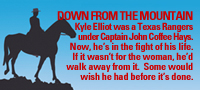
By the time he was 18, Kyle Elliot was fighting Plains Indians in the Old West, especially the most fierce warriors who’d ever ridden across the broad plains of Texas, the legendary Comanche. He’d ridden with Captain John Coffee Hays, in the Texas Rangers and learned to fight in ways most men never understood. “Captain Jack” had taught him and the men he’d ridden with, skills with weapons, tactics, fighting from a horse, tracking, and surviving in the deserts and mountains. Hays and his Rangers were the only fighting unit the Comanche feared. His band of Rangers tracked the Comanche to their home, raided them, fought them on their own terms and on their own terrain, and won. They’d done the same against the Lipon Apache. These men did what the army couldn’t do. They did what no fighting force would manage to do until decades later.

Western fiction novel Down From the Mountain

Elliot tells of his education with Captain Jack:

I once saw a Comanche buck race his horse towards us as we were approaching a ravine. He came out of some brush on a dead run, and before any of us could move, came to a sliding halt about fifty yards away. He just sat there staring at us, daring us. I kicked my horse in the ribs and gave a yell, but I hadn’t gotten twenty yards before Captain Jack brought me up short. I trotted back, angered that he’d stopped me. I wasn’t afraid of that Comanche, and I knew I could have run him down. I’d have shot him on the run. I was that good, and he knew it. I showed my irritation when I rode up to him and said, “You figure I ain’t up to that buck, Capt’n?”

He shook his head at me, gave me a half of a smile and said, “Just wanted to keep you and your hair around awhile longer, Elliot. That Comanche wanted all of  us to chase him.  Apparently, you haven’t learned a thing, yet.”

Well, I got a dressing down in front of all of them. I was just a kid, and it had been my first real foray, so they all had a good laugh at me. We never followed that Comanche.

Now, Elliot is headed to a small, sleepy little town, hoping to serve as marshal,  hoping he can avoid the problems he had in his last job, which involved having to kill several men, and getting in the middle of a range war. He accepted a lawman’s job in a peaceful town. It seemed to be perfect. But, Kyle Elliot would quickly learn that he’d need all the skills he’d learned as a Texas Ranger with Captain Jack to survive. The only thing that keeps him from leaving  is the woman who hired him.

*******

A gunslinger in the Wild West was fairly uncommon. A cowboy chasing “cow critters” could be found throughout the Old West.  In western books, historical fiction novels, or western novels, the western cowboys are a dime a dozen . (Maybe that’s where the phrase “dime novel” arose?)

Cowboy stories were common on the western open range, and those cowboys told a lot of those stories, but cowboy novels were not. A “cowboy western,” was pretty uncommon during the early days of western novels. Usually, the greatest westerns were about some gunslinger in the Old West, or a marshal or sheriff made larger than life, or a mountain man or Indian fighter (such as Buffalo Bill).

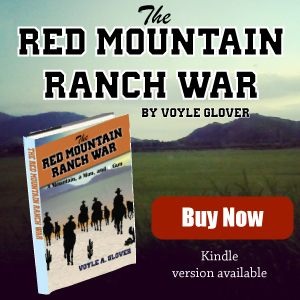
This is another western fiction novel of the highest caliber, an action packed adventure from Brevia Books by Voyle Glover, an author one reader said “reminds me of Louis L’Amour’s books. He was my favorite when it came to westerns.”

Voyle Glover,  author of several western novels, is an attorney, and says of his love for westerns: “I grew up thinking one day I’d be John Wayne. Now, I just write about those heroic figures that lit up my mind as a young boy.” Glover lived for 16 years in Arizona and has roamed the state, ridden many old trails, and camped and explored much of that state. When he creates a landscape scene in his books, he’s bringing to life a scene that he’s gazed upon at one time.

Good News for Lovers of Westerns | Western Fiction & Western Movies Rising in Popularity

Three Pieces of Good News for fans of Western Fiction & Old West Movies

1. HONDO IN 3D

Lots of good news out there for those of us who love westerns.  The western genre, both western fiction in books and in movies, has shown an increase in interest around  the country. One of the all time favorite stars of Old West movies, John Wayne, is about to have a kind of resurrection. Of course, Wayne has long been dead, but his movie, Hondo, is about now on 3D.  From NBC in Philidelphia comes this story:

John Wayne cuts a classic cowboy figure in 1953′s “Hondo,” one of his most beloved films. It’s a good time to be a John Wayne fan. One of the most iconic and prolific actors in the history of Hollywood, with an image that defined rugged, just-minded American manhood, Wayne’s cinematic legacy still remains vibrant on home video. Unparalleled classics like “Stagecoach,” “The Searchers” and “True Grit” have never seen their Western vistas that look more gorgeous than on Blu-ray. The latest treasure to emerge is the much beloved “Hondo,” the 1953 adaptation of a Louis L’Amour story that was originally produced for theaters – by Wayne himself – in 3D.

more…

2. LARGEST BOOKSELLER IN THE WORLD PURCHASES AVALON BOOKS

Avalon Books has just been scooped up by Amazon Publishing. The value for authors of westerns is that this has long been a venue for authors for the publishing of quality western fiction that is not profanity laced, and has stayed true to the old fashioned values such as practiced by Louis L’Amour, the premier western fiction writer of all times. Here’s a story you may have missed on the L.A. Times:

 On Monday, Amazon Publishing announced that it had purchased Avalon Books, a 62-year-old publisher. The acquisition means that Amazon Publishing has just added 3,000 titles to its list.  Avalon is an independent publisher that has focused on specific genres. In the past, that included science fiction. Now it primarily publishes mysteries, westerns and romance. While romance is hot right now — hot and heavy, like “50 Shades of Grey” — these novels are anything but. The books Avalon has published are, it writes, “good stories and wholesome entertainment.”

How good and how wholesome? Very good. Very wholesome. “There is no explicit sexual content or profanity in any of our novels,” Avalon states in its writers guidelines. “It is the author’s responsibility to heighten the romantic atmosphere by developing love scenes with tenderness, emotion, and perception

Q. WHAT IS TOO SEXY FOR AVALON?

A. Sexual tension is fine but not more than a kiss or embrace is allowed.

    Q. WHAT ARE THE RULES ON ROUGH LANGUAGE?

    A. No cursing throughout all of our books. Nothing heavier than a “hell,” “damn” in Westerns and Mysteries. We don’t like cursing at all in our romances. We do not accept racial epithets, no harsh language, and no sexy talk.   More…

3. WESTERNS GOOD FOR CABLE

There have been several westerns that have enjoyed enormous popularity with the viewing public. It seems that most of us who grew up on Roy Rogers and Gene Autry have a rather enormous hunger for movies on the Old West, and finally, those who produce such things are glimpsing that pile of green. Here’s a story about a new series, Longmire.

 Westerns Are Riding High on Cable: A&E Sets Network Record With Series Debut NY Times.

A&E set a network record with the debut of its new Western-style drama series, The New York Times’ Media Decoder reports. Sunday’s premiere of “Longmire” attracted 4.1 million viewers, more than any new drama series on cable TV this season, the story reports. Most of the show’s viewers were older, but it still attracted 1.4 million viewers in the 25 to 54 demographic, which is the main demo for the network, the story points out. The number is also the best in the demo this year for a new drama series, the story reports. More…

One day those who produce movies for a living are going to realize that there are millions of us older citizens who absolutely love all things western, whether it’s a western fiction novel, or a western movie, or shucks, even a restaurant with a western theme. We are fans of the Old West.  All in all, it’s looking good for westerns, and for those of us who write western books, and for those of us who love a good old fashioned western movie.


Amazon Image